Have you noticed a rough white or gray line forming around the waterline of your pool?
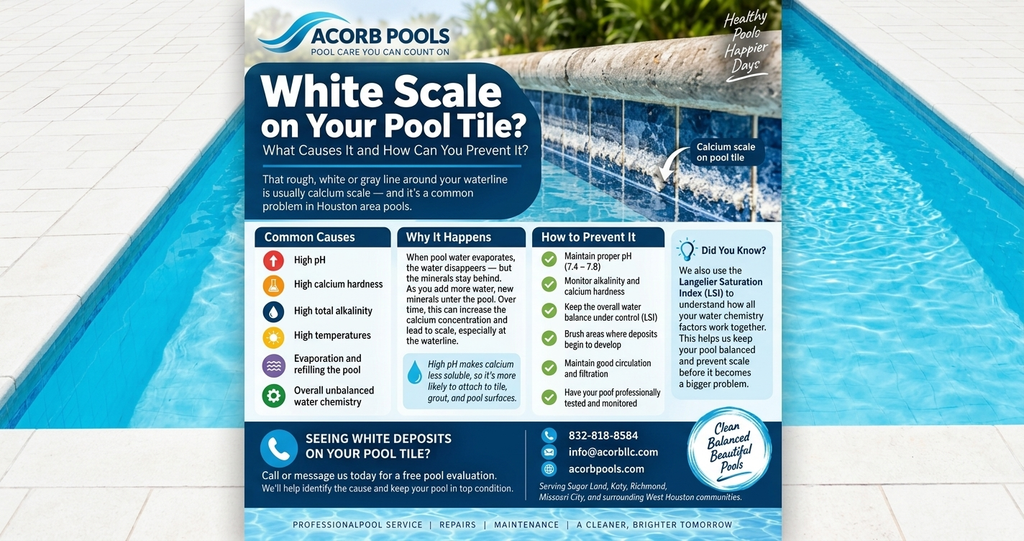
It may look like dried salt or dirt, but in many cases it is actually calcium scale.
Calcium scale is very common in swimming pools, especially in areas like Houston where high temperatures and evaporation can gradually concentrate minerals in the water.
💧 What causes calcium scale?
Scale usually develops from a combination of water chemistry conditions, including:
- High pH
- High calcium hardness
- High total alkalinity
- High water temperatures
- Evaporation and repeated refilling of the pool
- Overall unbalanced water chemistry
When pool water evaporates, only the water disappears. The calcium, salts, and other dissolved minerals remain behind.
Then we add more water to replace what was lost — and that new water brings additional minerals with it.
Over time, this process can increase the concentration of calcium in the pool and contribute to those stubborn white deposits you see around the waterline.
⚠️ Why pH matters
High pH is one of the biggest contributors to calcium scale.
As the pH increases, calcium carbonate becomes less soluble in the water and is more likely to come out of solution and attach itself to tile, grout, plaster, and pool equipment.
This is one reason proper pH control is important for much more than swimmer comfort.
📊 What about LSI?
At ACORB POOLS, we also pay attention to the Langelier Saturation Index, commonly called LSI.
LSI looks at several factors together, including:
- pH
- Total alkalinity
- Calcium hardness
- Water temperature
- Total dissolved solids
This gives us a better picture of whether your pool water has a tendency to become scale-forming or corrosive.
A pool can have individual chemistry readings that appear acceptable while the combination of those readings can still encourage scale.
🧱 Why does the scale appear at the waterline?
The waterline is constantly being wet and then exposed to evaporation.
A very thin layer of water evaporates repeatedly, leaving minerals behind.
At first, you may only see a light white film. If the underlying water chemistry is not corrected, those deposits can become thicker, rougher, and much more difficult to remove.
🧽 Can calcium scale be removed?
Yes, but the sooner it is addressed, the better.
Light scale may sometimes be reduced with proper chemistry adjustment and appropriate cleaning.
Older or heavier deposits can require specialized professional treatment.
It is also important to remember that not every pool surface should be cleaned the same way. Aggressive chemicals or improper scraping can damage tile, grout, natural stone, or pool finishes.
✅ The best solution is prevention
Regular pool maintenance can greatly reduce the chances of severe calcium buildup.
That includes:
✔️ Maintaining proper pH
✔️ Monitoring alkalinity
✔️ Monitoring calcium hardness
✔️ Keeping the overall water balance under control
✔️ Watching the LSI
✔️ Brushing areas where deposits begin developing
✔️ Maintaining proper circulation and filtration
A beautiful blue pool is important — but clear water alone doesn’t necessarily mean the water is properly balanced.
At ACORB POOLS, we monitor your pool chemistry and equipment every week to help identify developing problems before they become bigger and more expensive.
📞 Seeing white deposits around your pool tile?
Contact ACORB POOLS and let us help evaluate your pool water and determine what may be causing the scaling.
📱 832-818-8584
📧 info@acorbllc.com
🌐 acorbpools.com
Serving Sugar Land, Katy, Richmond, Missouri City, and surrounding West Houston communities.
👉 Call or message us today to schedule a free pool evaluation.