Fall in Houston, Sugar Land, Katy, and the surrounding areas may not bring the dramatic leaf season seen farther north, but falling leaves can still create serious problems for swimming pools.
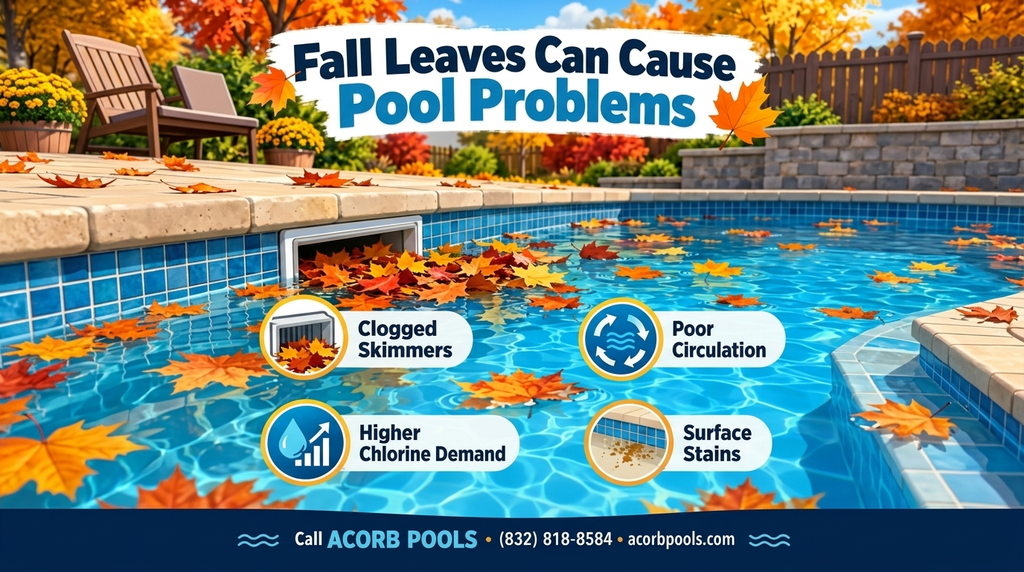
A few leaves floating on the surface may seem harmless. But when leaves are allowed to accumulate in your pool, skimmers, or equipment, they can affect much more than appearance. They can interfere with circulation, increase chlorine demand, clog filtration systems, stain pool surfaces, and even put unnecessary stress on your pool equipment.
At ACORB POOLS, we believe understanding what is happening inside your pool is just as important as keeping it looking clean.
1. Leaves Can Block Your Skimmer and Reduce Water Flow
Your skimmer is one of the main ways water travels from the pool to the pump and filtration system.
During the fall, leaves can quickly fill the skimmer basket. As the basket becomes packed with debris, water flow to the pump can decrease.
Reduced flow can lead to poor circulation and filtration. In severe cases, if the pump cannot get enough water, it may begin pulling air or lose prime.
A pool pump is designed to move water not air.
That is why a completely packed skimmer basket should never be ignored.
2. Leaves Can Also Fill the Pump Basket
Leaves and smaller debris that get past the skimmer may eventually reach the pump strainer basket.
When the pump basket becomes clogged, the pump has to work with restricted water flow.
You may notice:
🏊♂️ Lower pressure from the return jets, weak circulation, air inside the pump basket, difficulty maintaining prime, or reduced overall filtration performance.
What looks like a simple leaf problem can therefore become a circulation problem.
3. Decomposing Leaves Increase the Organic Load in Your Pool
Once leaves remain underwater, they begin to break down.
As organic material decomposes, your sanitizer has more material to oxidize.
That means some of the chlorine that should be protecting your pool from algae and microorganisms is instead being consumed by decomposing debris.
During periods of heavy leaf fall, chlorine demand can increase considerably especially when large amounts of organic material are allowed to remain in the water.
Removing leaves promptly helps your pool chemistry work more efficiently.
4. Leaves Can Contribute to Algae Problems
Leaves do not directly “cause” algae simply by falling into the water, but accumulated organic debris creates conditions that can make algae control more difficult.
Poor circulation, higher chlorine demand, dirty filters, debris collecting in corners, and decomposing organic material can all work together against you.
A pool can therefore go from looking perfectly clear to developing algae surprisingly quickly when circulation and sanitation are compromised.
This is another reason we always say:
Pool chemicals alone don’t keep a pool clean.
Proper chemistry must work together with good circulation, filtration, brushing, vacuuming, and debris removal.
5. Leaves Can Stain Pool Surfaces
Wet leaves sitting on steps, benches, tanning ledges, or the pool floor can release natural pigments and tannins as they decompose.
Over time, these substances may leave brown or yellow discoloration on plaster and other pool surfaces.
The longer the leaves remain in contact with the surface, the greater the possibility of staining.
Removing leaves quickly is much easier than trying to remove a stain later.
6. Your Filter Has to Work Harder
Everything that stays in the pool eventually has to be removed somehow.
Smaller particles from deteriorating leaves can travel through the circulation system and end up in the filter.
As debris accumulates, the filter becomes dirtier and water flow can gradually decrease.
Depending on the type of filter and the amount of debris entering the pool, fall conditions may mean your filter needs attention sooner than expected.
A clean filter is essential for good circulation and clear water.
7. A Full Skimmer Basket Can Become a Bigger Problem Very Quickly
This is particularly important after windy days or storms.
A skimmer that was relatively clean in the morning can become completely packed with leaves within hours.
For homeowners with trees close to their pools, checking the skimmer basket more frequently during periods of heavy leaf fall is one of the easiest ways to help protect the circulation system.
It takes only a few minutes but it can help prevent a much bigger problem.
Fall Pool Care Is About More Than Removing Leaves
Keeping leaves out of your pool isn’t just about making the water look attractive.
It helps protect:
💧 Water circulation.
🧹 Filtration.
🧪 Chlorine efficiency.
✨ Pool surfaces.
⚙️ Pump performance.
🧼 Overall water quality.
At ACORB POOLS, our weekly pool service goes beyond simply removing debris from the surface. We inspect the pool, maintain proper water chemistry, empty baskets, brush and vacuum as needed, monitor circulation, and check the equipment for signs of potential problems.
Because a clean-looking pool isn’t necessarily a properly maintained pool.
We Don’t Just Skim and Go.
Need Help Keeping Your Pool Clean and Properly Balanced This Fall?
Whether you need reliable weekly pool service, filter cleaning, equipment repair, water chemistry assistance, or help diagnosing a circulation problem, ACORB POOLS is ready to help.
📞 Call: (832) 818-8584
✉️ Email: info@acorbllc.com
🌐 Website: www.acorbpools.com
📍 16834 Aprilmont Dr., Sugar Land, TX 77498
Serving pool owners throughout Sugar Land, Katy, Houston, Fort Bend County, Harris County, and surrounding areas.
Contact us today for a free pool service quote.