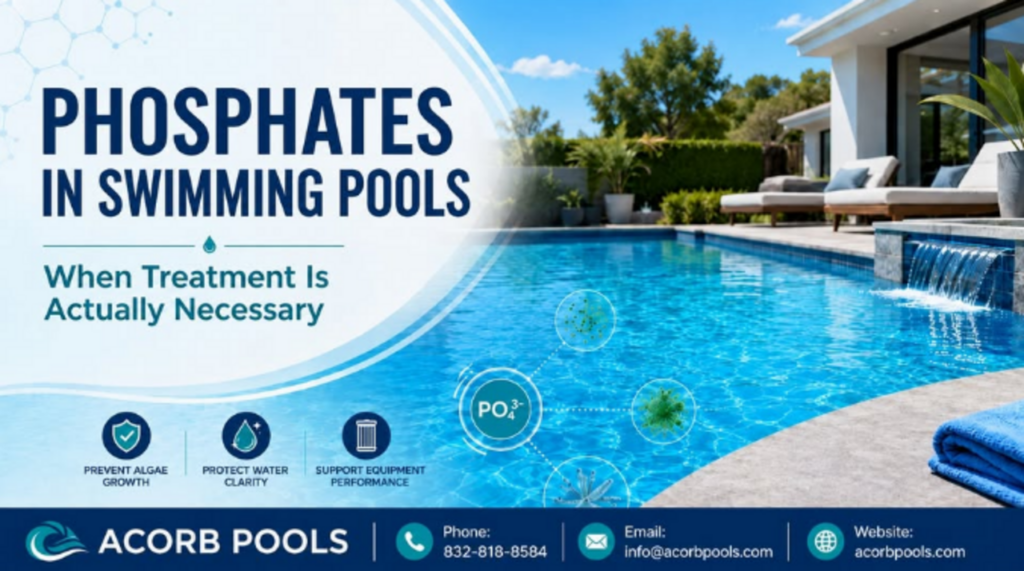
Phosphates are a common concern for pool owners, especially during Houston’s hot summer months. They are nutrients that algae can use to grow, and they may enter a swimming pool through rainwater, lawn fertilizer, leaves, soil, swimmers, fill water, and certain pool chemicals.
A phosphate reading does not automatically mean that your pool has a serious problem. However, when phosphate levels become elevated, they can make algae more difficult to control and increase the amount of chlorine needed to keep the water clean.
What Are Phosphates?
Phosphates are compounds containing phosphorus. They are usually invisible in pool water and do not directly make the water unsafe. The concern is that they can serve as a food source for algae.
Chlorine is still the pool’s primary defense against algae. A properly sanitized pool may remain clear even when phosphates are present. However, high phosphate levels can reduce the margin for error. When chlorine drops because of heavy rain, intense sunlight, equipment problems, or increased swimmer use, algae may develop more quickly.
When Is Phosphate Treatment Necessary?
Phosphate treatment should be considered when:
The phosphate level is significantly elevated.
The pool repeatedly develops algae despite proper cleaning and chemical maintenance.
Chlorine demand is unusually high.
The water becomes cloudy or develops green areas soon after treatment.
The pool has recently received fertilizer runoff, excessive organic debris, or contaminated fill water.
The pool is entering the warmest part of the year, when algae growth is more aggressive.
As a general target, phosphate levels below approximately 100 parts per billion are considered very low. Once readings rise above several hundred parts per billion, phosphate control may become beneficial, particularly in pools with recurring algae or chlorine demand problems.
The phosphate reading should always be evaluated together with the pool’s chlorine, pH, alkalinity, cyanuric acid, circulation, filtration, and overall condition.
High Phosphates Are Not the Only Cause of Algae
It is important not to treat phosphates as the explanation for every pool problem. Algae can also result from:
Insufficient free chlorine
Excessively high cyanuric acid
Poor circulation
Inadequate pump runtime
A dirty or damaged filter
Areas of the pool that are not brushed regularly
Equipment or plumbing problems
Adding phosphate remover without correcting these underlying conditions may provide only temporary improvement.
What Happens During Phosphate Treatment?
Phosphate remover reacts with the phosphates in the water and forms very small particles. These particles are then captured by the pool filter.
Because of this process, the water may appear cloudy or hazy for up to approximately 24 to 48 hours after treatment. This is often a normal part of the removal process rather than a sign that the treatment has failed.
The pump must run long enough to circulate the product throughout the pool, and the filter should be monitored carefully because it may collect a significant amount of material.
Why Filter Cleaning Is an Important Part of the Process
Phosphate remover does not simply make phosphates disappear. It transfers them from the water into the filter.
If the filter is not cleaned after treatment, the captured material remains inside the filtration system. This can restrict water flow, increase filter pressure, reduce circulation, and interfere with the effectiveness of the treatment.
For this reason, professional phosphate removal often includes:
Testing the phosphate level.
Calculating and applying the correct treatment amount.
Circulating the water.
Monitoring filter pressure and water clarity.
Cleaning the filter.
Retesting the water after treatment.
Very high phosphate levels may require more than one treatment cycle. The first treatment may significantly reduce the concentration without immediately bringing it to the lowest possible level.
Should Every Pool Be Treated?
No. A clear, properly sanitized pool with stable chemistry may not require phosphate removal simply because phosphates are detected.
Treatment becomes more valuable when phosphate levels are high and the pool is experiencing algae, excessive chlorine demand, cloudy water, or repeated chemical instability. The decision should be based on the complete condition of the pool rather than one number alone.
Professional Phosphate Testing and Treatment
At ACORB POOLS, we evaluate phosphate readings together with the pool’s sanitation, circulation, filtration, and water chemistry. When treatment is appropriate, we use the correct amount of phosphate remover, monitor the pool during the process, and clean the filter to remove the material captured from the water.
Concerned about high phosphates, recurring algae, or unusually high chlorine use? Contact ACORB POOLS for a professional pool evaluation.
ACORB POOLS LLC
Phone: 832-818-8584
Email: info@acorbllc.com
Website: acorbpools.com